Communicating the Integrity Code

A guide for sport and recreation organisations

Getting started

Congratulations on your organisation’s decision to work towards adopting the Code for Integrity in Sport and Recreation (Integrity Code). Your organisation joins a growing number committed to working together to create safer, fairer sport and recreation for everyone in Aotearoa New Zealand.

The Integrity Code sets minimum standards that protect all sport and recreation participants. Clear and thoughtful communication helps to bring those standards to life. It helps your team and members understand the changes that are taking place, believe in the reasons for the change and inspire them to be part of the movement.

Communicating about the Integrity Code is an important job that aims to change behaviour across your organisation. We encourage a holistic approach that spans leaders, teams and touchpoints.

Integrity Code communication is also ongoing. It doesn’t stop on your formal adoption date; rather, your formal adoption date is the start of a communications topic that will become BAU across your organisation.

Reading this guide will help you to keep your community informed, prepared and motivated as your organisation prepares to adopt the Integrity Code.

Appendix A contains suggested messages for communicating key Integrity Code information. You can use these messages at any time and adapt them to suit your organisation's tone and style.

Appendix 2 is a pre-adoption communications plan shared with us by NZ Ultimate.

Appendix 3 is an Integrity Code communications one-pager – the gist of this guide on a single page to help you plan your communications throughout the adoption process.

Who this guide is for

This guide will be most useful for organisations working towards adopting the Integrity Code or their one-year compliance date.

Although this guide is a tool to support communication work, it is not just for communication teams. It will be useful for all kaimahi involved in implementing the Integrity Code.

How to use this guide

This guide is structured around the stages of adoption: Understand, Plan, Adopt, and Grow.
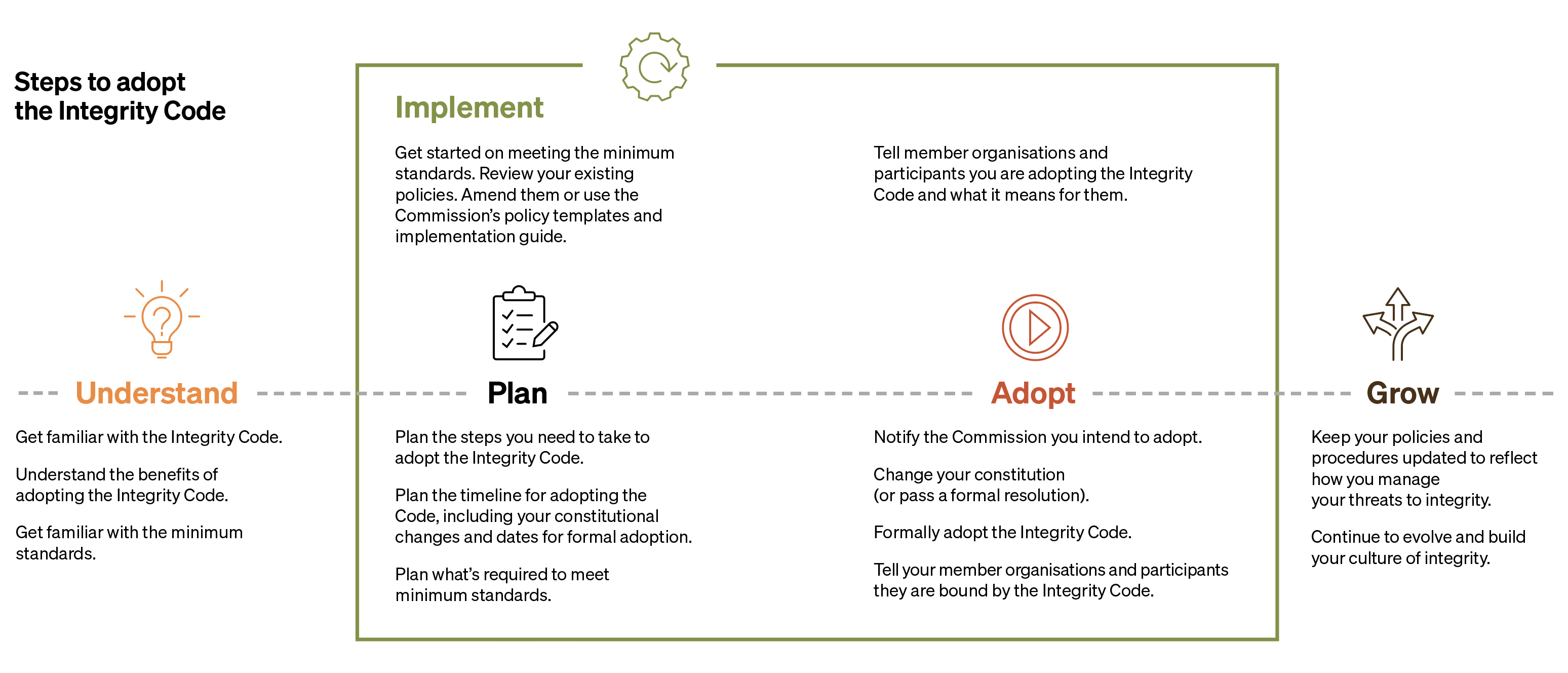
Read a written description of the Steps to adopt the Integrity Code image.

Where possible, we recommend that communicators and integrity leads read this guide in the Understand stage of adoption. It will help you understand what your communications about the Integrity Code must achieve to meet the six minimum standards that make up the Code.

The Plan stage will see you take steps to prepare how you will communicate to your membership about the Integrity Code.

Implementation happens throughout the adoption process. It isn’t linear and will be different for each organisation. For example, you may introduce new or updated policies long before you reach the Adopt stage.

By the Adopt stage - specifically, by the effective adoption date - your membership must be clear about what is happening and why. This is also when you will announce and celebrate your effective adoption and emphasise to your members that they are now bound by the Integrity Code.

The Grow stage will see you deliver and refine your integrity communications as you work to meet the minimum standards and communication about the Integrity Code becomes business as usual.

Understand stage

01

Intro to the Understand stage

In this early stage, your organisation will explore what it means to work towards the minimum standards and comply with the Integrity Code.

Every organisation starts from a different place, so the work required will vary. Some organisations may only need minor updates to existing policies and practices, while others may need to make more significant changes.

Your communication approach will also depend on your organisation's circumstances. Consider your current level of readiness, the changes that need to be made, who will be affected, how those changes will impact them, and how much time is needed to communicate effectively.

A well-paced approach helps members understand what is changing, why it matters, and what they can expect throughout the adoption journey.

02

The minimum standards

At the heart of the Integrity Code are the six minimum standards. Each of these has requirements that your organisation must meet to adopt the Integrity Code.

Minimum standard 1: Prohibit behaviours that are a threat to integrity

Minimum standard 2: Proactively safeguard children, young people and adults at risk

Minimum standard 3: Implement an effective and fair dispute resolution process in relation to integrity threats.

Minimum standard 4: Notify the Commission of issues of serious concern.

Minimum standard 5: Cooperate with the Commission in relation to dispute resolution, investigations and monitoring activity.

Minimum standard 6: Provide information to your members about the Integrity Code.

Learn more about the standards and their requirements at Adopting the Integrity Code

03

Key deadlines and requirements

There are a few key deadlines to note on your organisation’s adoption journey:

  • Notice of adoption date

  • Effective adoption date

  • Compliance date

Notice of adoption date (Notice date)

This is the date your organisation formally notifies the Commission that it will adopt the Integrity Code. As part of that notification, your organisation will propose an effective adoption date.

It is expected that you will have already begun communicating to your members about the Integrity Code by this date. It's helpful to submit your pre-adoption communications plan along with your notification documents.

Effective adoption date – minimum standards five and six in force

The effective adoption date is the date your organisation formally adopts the Integrity Code. This comes 1 month or more after your notice date.

By the effective adoption date, you must meet minimum standards five and six.

That means you must have told your members about:

  • your formal adoption of the Integrity Code

  • each new or updated policy that implements the Integrity Code

  • where they can access policy documents

  • their right to make a complaint to your organisation or the Commission.

Compliance date – all minimum standards in force

The compliance date comes 12 months after your effective adoption date. Your organisation must meet all six minimum standards by this date.

You must tell your members:

  • about new policies and where to find them

  • about the right to complain to your organisation and the Commission

  • how they can put the Integrity Code into practice.

04

Framing early changes

Early changes are a chance to start talking about integrity to your team and members. You might tell your community from the start that you are preparing to adopt the Integrity Code. Or you might start with simple integrity messaging that builds over time to introducing the Integrity Code to your members.

For both approaches, early changes are an opportunity to frame future integrity conversations, prepare and inform your community and build motivation for the journey to come. This narrative is likely to connect to your integrity vision, which we will talk about in the next section.

At this stage, your members don’t need details about the Integrity Code. They need to know:

  • What is happening – for example, you’re reviewing your safeguarding policy and processes

  • Why it is happening – For example, to make your organisation a safer, fairer and more respectful environment

  • When it is happening – Including any key milestones or communications you have planned

  • How it will affect them – Either now or in the future

Example

We’re committed to keeping [activity] safe, fair and fun for all our members. To support this, we’ll be reviewing our policies and processes over the coming months to make sure they continue to reflect current best practice. We’ve got strong foundations and this work aims to make sure that we’re meeting the needs of our sport/activity and community as we continue to grow. We’ll be in touch with updates as the work progresses. Thanks for your support.

For messaging support, see Appendix A: Integrity Code messaging

05

Communicating policy changes

You might make changes to your policies long before you settle on an effective adoption date. It’s good practice to communicate those changes to your members as they’re made. This becomes a requirement once you reach your effective adoption date.

Keep your members informed about:

  • policies your organisation introduces to meet the Integrity Code

  • policies that are updated or strengthened

  • policies that are being developed and will be introduced soon

  • how members can access the policies.

You don’t need to communicate every policy detail. Instead, help your members understand what has changed and why, and how the change helps create a safe and fair environment.

06

Communicating with young people

Before you begin your Integrity Code communications, it’s useful to think about how you will communicate changes to the children and young people in your membership.

Children and young people can be easily overlooked in communication about policy or process. However, they have the same right as adults to understand what safe and respectful participation looks like and how to get help if something doesn’t feel right.

Your communications should tell children and young people:

  • that they have the right to feel safe and respected

  • what behaviour is expected

  • that they can speak up if something doesn’t feel right

  • who they can talk to for help.

Your approach to communicating with children and young people will be more effective if you keep in mind the following principles:

  • Use simple language – Young people won’t understand complex policy language. Use clear words and short sentences that are easy to understand.

  • Focus on everyday situations - Use examples that children and young people recognise from their sport or activity, such as behaviour during training, competitions or travel.

  • Keep messages short and visual - Posters, short videos, infographics or simple checklists are easier to understand than long documents.

  • Repeat messages regularly - Children and young people learn through repetition. Reinforcing messages during trainings, briefings or season meetings can help them remember.

Case study: Scouts Aotearoa Safeguarding policy

Scouts Aotearoa’s Safeguarding policy is an example of best practice youth communications.

It takes the form of a children’s book and is worded carefully to make sure it holds its own as a Safeguarding Policy. There is no adult alternative. It uses bright, friendly visuals and simple language to show children what to expect from the people around them and how to get help if they need to.

Read the Scouts Aotearoa Safeguarding Policy

07

The role of parents and guardians

Once you reach your formal adoption date, it’s a requirement that you communicate with the parents and guardians of young people in your organisation – even if they themselves are not members.

It’s a good idea to start thinking about how you will reach them: do you have existing channels or do you need to establish something new?

At minimum, you will need to tell them:

  • that the organisation is bound by the Integrity Code

  • about any new or updated policies

  • where to find those policies

  • about their right to raise concerns with your organisation or the Commission.

Plan stage

01

Intro to plan stage

During the Plan stage you will create a communications plan to support your Integrity Code adoption. It’s a good idea to put your communications plan into action early to give your team and members time to understand what is happening, why it is happening and how it affects them.

For ideas and messaging support see Appendix A: Integrity Code messaging

02

Craft a powerful integrity vision

A clear and inspiring integrity vision is one of the most powerful items in your toolbox. It is your “why”, a concise declaration of your long-term integrity aspirations and the future you will build through adopting the Integrity Code.

You’ll use this vision almost any time you communicate the Integrity Code. Your vision helps you to:

  • set expectations

  • guide behaviours

  • inspire your community

  • reinforce the integrity culture you’re building.

Express your vision in a short statement – no more than a couple of sentences long. Keeping it short and meaningful will make it easy to remember and share. Make sure it reflects your unique context, values and strategic priorities. It’s likely that you’ll use words from your strategy and values within your vision statement.

Case study: NZ Esports

NZ Esports was the first organisation to adopt the Integrity Code. In their communications, they linked their integrity vision to their commitment to:

  • establishing safe and inclusive esports environments

  • growing esports

  • leading integrity in esports globally.

“The adoption of this framework underscores our commitment to the highest standards of safety and fairness. This initiative is fundamental to our strategic objective of creating a secure and inclusive esports ecosystem, providing a strong foundation that will empower our future expansion into specialised digital integrity protocols for the world of esports”

Read the full statement from NZ Esports

How you might use your vision

Your integrity vision might be focused on safety and inclusion. Here are some examples of how you might convey this vision over time and throughout your communications:

Sample vision: We’re adopting the Integrity Code to create spaces in which every member of our community feels safe, respected and celebrated for who they are. Together, we can keep inclusivity and belonging at the heart of our sport.

Purpose

Example

Explain why adopting the Integrity Code matters

We’re adopting the Integrity Code to make sure every member of our community feels safe, respected and celebrated for who they are.

Explain why policies are changing

Everyone deserves to feel safe and respected in our environments. That’s why we’ve introduced a new Prohibited behaviour policy to make clear what behaviours are unacceptable in our organisation.

Guide behaviour

You should feel safe and included both on and off the track. Speak to us if something doesn’t feel right.

Celebrate success

Thanks to everyone who completed safeguarding training in July. Your mahi helps make sure our members are safe and having fun.

03

Start early

Plan to communicate early to give your member organisations and members time to process and understand what adopting the Integrity Code means for them.

You may want to set up a communications hub to support communications within your organisation. Or, you may just want to rely on your existing communications channels, such as emails, newsletters and intranet. It’s a good idea to follow up with hui, allowing your community to come together to ask questions and talk through what it means to adopt the Integrity Code.

The goal is the same however you communicate: by the time you reach your Integrity Code effective adoption date, your community needs to understand what is happening and why.

Case study: Cycling NZ’s Code adoption support hub

Cycling New Zealand (CNZ) created an online Code adoption support hub as they work towards adopting the Integrity Code. The hub aims to share information across their member organisations as a ‘one source of truth’.

The hub shares messaging and information on:

  • what adoption would mean for member organisations

  • step-by-step guidance

  • FAQs

  • contacts for support

  • tailored learning resources for different roles, like board and committee members, coaches and volunteers

The hub provides CNZ’s nationwide member organisations with a single, reliable source of truth about adopting the Integrity Code.

By launching the hub early, CNZ is helping its member organisations prepare for change, ask questions and build capability and confidence ahead of time. It’s a great example of how a strategic and targeted approach can streamline change and lift understanding and engagement across a sport.

Visit Cycling NZ's Code Adoption Support Hub

04

Cascade your communications

An important part of developing your communications plan is considering how to make sure that your communications reach everyone in your organisation in the right order and from the right source. The aim is to prepare each level of the organisation to speak about integrity before moving on to the next.

Your cascade plan shows how your messages travel through the hierarchy of your organisation: starting at the top and flowing all the way to the sidelines, changing rooms, clubrooms and whānau.

A sample cascade action plan might look like this: National body > Regional body > Club > Coaches and officials > Volunteers > Parents/Whānau > Participants.

The plan could outline:

  • who delivers the message

  • who they deliver it to

  • how and when they deliver it

  • what resources they need to deliver the message and answer questions.

Support your leaders

For your cascade to be successful, you need to empower your people to talk confidently about your integrity vision and the Integrity Code.

Prepare them with information with key messages about:

  • your “why”

  • what the Integrity Code is and does

  • the process and expected timeline

  • answers to common questions.

Later in the Integrity Code adoption process, you may want to invite other influential people in your organisation to help champion integrity at all levels. It might be someone well-known who doesn’t have a leadership role, like a popular athlete or respected coach.

Whoever you choose, make sure they’re prepared with messaging that can help them talk about integrity as a shared value.

05

Phase your communications

Big ideas can feel overwhelming if they’re not broken down. Phasing your communications means breaking down what you want to communicate into phases and actioning over time. This approach avoids overwhelming your members, gives them time to digest new information and allows space for change.

The phases you use, along with their purpose, messaging, activities and timeframes, will be different for each organisation. It depends on your readiness to adopt, your organisational structure and other factors.

Example phased communication plan

Phase

Purpose

Messaging

Activities

1: Prepare and listen


Build internal understanding and capability.

“Integrity matters here”


“We are preparing for change”


“Here’s what to expect”

Build internal readiness


Draft the integrity vision


Start with staff and leaders

Create opportunities for member input.

2. Announce and align


Share your integrity vision; explain the why; outline what’s changing.

“We’re adopting the Integrity Code”


“Here’s why”


“What this means for you.”

Announcement from CE/Chair.


Overview of impact by role.


Online and in-person hui for questions and discussion.


3. Learn and equip


Give people tools and training to act.

“Here’s what you need to do”


“We’ll make it easy.”


“Your actions matter”

Micro-learning videos; short workshops.


Checklists and scenario cards in activity spaces.


Reporting flowchart posters.


Role-specific expectations (1-page per role).


4. Embed and nudge


Reinforce habits; make integrity visible

“This is how we roll”


“Small actions, big impact.”


“Here are good examples from our organisation”

Weekly integrity “moment” at trainings or meets.


Peer shout-outs; coach reminders; consistent signage.


Quick audits (for example, changing room safety checks).

5. Celebrate and improve


Sustain momentum; learn and adapt.

“Thank you”


“Here’s the impact”


“What’s next.”

Share stories and data highlights.


Recognise teams/ individuals; refresh training where needed.


Feedback loops; update policies annually.


Case study: NZ Ultimate’s pre-adoption communications plan

NZ Ultimate drew up and implemented a simple and effective communications plan. It encompasses the first phase of their communications and takes place across the months before the organisation’s effective adoption date.

NZ Ultimate gave their members the most information first: what, why, how they will be affected and an approximate timeline. They included a clear vision based in the organisation’s values.

See Appendix 2 for NZ Ultimate’s pre-adoption communications plan.

Adopt stage

01

Intro to the Adopt stage

The Adopt stage covers the months leading up to your Integrity Code adoption, including the effective adoption date itself.

Once your effective adoption date is established, our communications team will reach out to discuss your adoption announcement. We ask that you keep your communications internal until we have discussed a coordinated external communications approach.

As your effective adoption date approaches, make sure your members understand what is happening and when. That includes keeping your community informed about important milestones like AGM meetings, constitution updates, votes and policy changes.

02

Making information, policies and resources available

Members must be able to easily find and read your policies. This means that you must:

  • publish policies somewhere that’s easy to access

  • make policies freely available

  • clearly communicate where members can find them.

It may be helpful to have an integrity section on your website so that all your policies are in one place, and that they’re supported by wider integrity information and resources. It makes it easy for members and the public to understand the work your organisation is doing to keep your spaces safe and fair for everyone.

Your integrity section can include:

  • Your integrity vision

  • An overview of the Integrity Code and how it supports your vision

  • Links to policies, processes and resources

  • Anti-doping information (if relevant for you)

  • A guide to making complaints or speaking out

  • Details for key contacts

  • Contact details for the Commission.

Find support for communicating policy changes in Appendix A: Integrity Code messaging

03

Planning your external announcement

This is an exciting opportunity to celebrate your organisation, your values and your commitment to integrity.

We will work with you on a timeline for announcing your Integrity Code adoption – usually on your effective adoption date.

There is no single approach. We may ask to work with you on a media release and shared social media assets to celebrate. We may prefer to announce several adoptions at the same time or invite you to lead the announcement and share a quote from our CE to support your work.

The most important thing is that we work together on the approach.

What to tell your members on adoption day

Minimum standards five and six come into effect on this day. To meet these minimum requirements, you must tell members:

  • that your organisation has formally adopted the Integrity Code

  • about any new or updated policies that implement the Integrity Code

  • where members can access policies

  • that members have the right to make a complaint to your organisation or the Commission.

Your internal message to members should be about more than just meeting the minimum standards.

It's an opportunity to celebrate your organisation's commitment to integrity and to explain what adopting the Integrity Code means for your members.

You can use this moment to reinforce your vision, values and culture, while highlighting the benefits members can expect – safer, fairer and more respectful sport and recreation environments.

Sample adoption day communications

We are proud to announce that we have formally adopted the Code of Integrity for Sport and Recreation (Integrity Code), effective today.

We join a growing community of sport and recreation organisations leading the way in strengthening safety, fairness and respect across the sector. Adopting the Integrity Code places our members at the heart of everything we do. We commit to keeping our spaces safe and respectful so that everyone can thrive.

What this means for you

Adopting the Integrity Code means that:

  • all staff, members and member organisations are now bound by the Integrity Code

  • minimum standards for safety, behaviour and fair processes apply to us all

  • if something goes wrong, you can raise concerns with us or the Sport Integrity Commission

  • we must all cooperate with the Sport Integrity Commission when required

Our policies

Our updated/amended policies put the Integrity Code into practice in our organisation. Find out what has changed and read the full policies at [URL]

Ask questions

If you have any questions about the Integrity Code or what it means for you, please contact [Integrity Lead details].

Thank you for working with us to keep [SPORT/ACTIVITY] safe and fair.

Grow stage

01

Intro to Grow stage

From your adoption date, you are in the Grow stage. This stage means embedding integrity communications into your everyday processes, behaviours and environments.

The purpose from now is to celebrate and reinforce why your organisation has chosen to adopt the Integrity Code, highlight key messages about what adoption means for your members and make sure everyone understands their role in keeping people safe.

02

Repeat messages across channels

People need to hear messages multiple times across different channels. Imagine your members:

  • see a poster about safe changing room practices at the club

  • hear a coach reinforce those safe practices at training

  • read a post about member protection on your club’s social media account

  • find a ‘safe changing room’ checklist in their volunteer induction pack.

Repetition increases the importance of the participant safety, highlights its relevance and makes it memorable.

It’s useful to plan your communications by audience to make sure each receives relevant messaging through channels that will reach them.

Example channel plan

Audience

Channel

Cadence

Staff

Organisational newsletter

Monthly

Meeting agendas

Weekly

Intranet

Always on

Players or participants

Team briefings or meets

Weekly

Posters

Quarterly

Website

Always on

Social media

Fortnightly

Coaches or officials

Hui or webinars

Monthly

Checklists

Always on

Leader notes

Weekly

Parents or whānau

Email newsletter

Monthly

Social posts

Weekly

Website

Always on

Event briefing

As needed

Volunteers

Induction packs

Onboarding

WhatsApp/FB groups

Weekly

Noticeboard

Always on

Admins or Board

Governance updates

Monthly

Dashboard or review

Quarterly

Policy refresh

Annually

03

Use environmental reminders

Reminders in people’s environments are powerful. They serve as ‘nudges’, subtle cues that reinforce integrity behaviours in the moment. Place messages where they matter most, like:

  • Posters on toilet doors: “We all play a role in keeping each other safe. Speak up if something doesn’t feel right.”

  • Positive behaviour banners on the field: “Respect each other. Respect the game."

  • Membership and registration forms: “By registering for this event/as a member of this organisation, you commit to creating safe and fair spaces and being bound by the Integrity Code”

  • Volunteer packs that include guides and checklists for safe practices: “We all play a role in keeping people safe, especially our volunteers. Our guidelines for safe changing rooms ensures everyone in our community is safe, respected and able to thrive.”

04

Provide clear expectations by role

People are far more likely to embrace change when they know exactly what’s expected of them and how to do it.

Clear expectations by role show everybody what ‘good’ looks like. You can communicate these via social media, newsletters, inductions, checklists, team meetings or other channels.

Examples

Role

Ideas

Players

Start each training session with an integrity chat. Include reminders or acknowledgements of good behaviour

Place posters in changing rooms and clubrooms

Share clips on social media of players modelling positive actions

Draw up a ‘Player Code’

Coaches

Set expectations during training or induction

Provide laminated field/court-side checklists (for example, about safe communication)

Add integrity messaging to a monthly coaching bulletin

Include talking points in weekly plans or training notes

Volunteers

Set expectations in event or activity briefings

Make integrity a part of induction

Use your volunteer communications tool (for example, WhatsApp) to remind volunteers of key behaviours

Add posters or reminders to volunteer hubs

Officials

Recognise officials who model positive integrity behaviours

Share pre-game information sheets with key integrity information (for example, reporting procedures)

Debriefing after an integrity issue has been managed

Parents and whānau

Set expectations at season launches and trainings

Share a ‘Parents pack’ containing information on positive behaviour and reporting procedures

Staff and administrators

Include expectations into role descriptions and inductions

Add integrity as a standing agenda item for meetings

Provide workflow checklists (for example, processes for handling reports)

Share reminders in internal newsletters or intranet.

05

Provide resources

Practical tools help member organisations, staff, volunteers and participants to put new behaviours into practice. They remove guesswork, reduce inconsistency and make integrity feel achievable. They’ll also build trust across your organisation as members understand that that adopting the Integrity Code is a supported, collective journey and not something they have to figure out on their own

Example resources

  • *Safe practices guides and checklists (for example, travelling with children)

  • *Micro-learning modules

  • *Full-length online education

  • *Policy templates and explainers

  • Quick reference cards for different roles

  • Scenario cards for induction and training

  • Flowcharts for important processes like raising concerns.\

You can find resources marked with an asterisk (*) available on our website.

Browse our resources

06

Recognise and celebrate positive examples

Celebration is more than a feel-good moment. It’s a powerful motivator for behaviour change. When your members see their efforts to support integrity recognised, they’ll feel proud; others will see that integrity matters and the work it takes is noticed and celebrated.

Celebrating success doesn’t have to be big or formal. Small, consistent gestures can make a huge impact. Think about the energy in a team meeting when a coach says, “Shout-out to our players for showing awesome respect to the officials last weekend!” Or the pride on a volunteer’s face when they receive a “Safeguarding star” badge for completing training early. These moments reinforce the behaviours you want more of and make integrity part of your culture.

Examples

  • Shout-outs: Weekly or monthly recognition in team meetings or social posts.

  • Awards: “Safeguarding star” badge for those who complete safeguarding education early

  • Spotlight on social: Spotlight positive behaviours, for example with a “Fair Play Friday” theme on social media

  • Storytelling: Share short videos from members sharing what integrity means to them, and why

  • Data highlights: “Every volunteer is police checked and safeguarding trained. Together we’re creating safer spaces for tamariki and rangatahi”

  • Prizes: Include a short “Integrity moment” in prizegivings or encourage your community to vote for an “Integrity superstar”

These celebrations build a sense of shared achievement and show that integrity is something everyone contributes to.

Appendix 1: Integrity Code messaging

01

How to use this messaging

This appendix contains basic messaging to support communications to your staff and members, including:

  • Participants and athletes

  • Coaches and volunteers

  • Parents, guardians and whānau

  • Children and young people

You can use these messages at any time. We encourage you to adapt them to reflect your audience, the channel and your organisation’s values and voice.

The key message is that the Integrity Code helps make sport and recreation safer and fairer for everyone.

The topics:

  • What the Integrity Code is and does

  • The Integrity Code commitment

  • What adopting the Integrity Code means for members

  • Talking about timelines and changes

  • Summarising policies and changes

  • Embedding minimum standards

02

1. What the Integrity Code is and does

The Integrity Code is a framework that supports safe and fair sport and recreation for everyone in Aotearoa.

It aims to make sure participants are safe, respected, treated fairly and taken seriously if things go wrong.

It does this by setting minimum standards for integrity, including how to treat and protect people, how and when to report concerns, and how to manage complaints and issues – including serious ones.

By adopting the Integrity Code, we join a growing number of sport and recreation organisations leading the way in strengthening safety, fairness and respect across the sector.

The Integrity Code applies to/will apply to and protects everyone in our organisation, including staff, volunteers, officials, administrators and participants. It applies at all levels, from local clubs to national organisations.

The Integrity Code:

  • bans harmful behaviours like abuse, discrimination, match-fixing and fraud

  • sets out fair processes that hold people to account if they do something wrong

  • strengthens safeguarding practices

  • outlines clear processes for making complaints

  • requires us and our members to cooperate with the Sport Integrity Commission Te Kahu Raunui when appropriate; and

  • makes it a priority to keep members informed.

The standards are the same across any sport or recreation organisation that has adopted the Integrity Code. By adopting the Integrity Code, we are lifting levels of safety and fairness across the sector.

We all have a role to play in keeping [SPORT/ACTIVITY] safe and fair.

03

2. The Integrity Code commitment

By adopting the Integrity Code, we commit to the six minimum standards. This means:

  • Creating a respectful environment where harmful behaviour is not tolerated.

  • Protecting our members, including children, young people and adults at risk.

  • Providing fair, safe and accessible ways to raise concerns and resolve complaints.

  • Taking serious integrity concerns seriously and reporting them when required.

  • Working with the Sport Integrity Commission when appropriate.

  • Keeping our members informed, supported and aware of their rights and responsibilities.

04

3. What adopting the Integrity Code means for members

Adopting the Integrity Code gives us the tools to build a culture that’s stronger, safer and fairer for all – and you have an important role to play.

You may need to adopt new ways of working. If you work with young people, for example, you may need to complete more safety checks or training. We’ll support you with safe practices, processes and resources.

Most importantly, the Integrity Code is about helping everyone feel safe, respected, included and confident that concerns will be taken seriously if something goes wrong.

From the date we adopt the Integrity Code, everyone in our organisation must:

  • Follow rules that uphold integrity. This includes not engaging in behaviours like bullying, harassment, discrimination or match-fixing

  • Adopt updated safeguarding measures. This includes undertaking regular safety checks, completing annual training and adopting safe practices that protect young people and adults at risk.

  • Report integrity issues to us using the processes we share with you. You can also report issues directly to the Sport Integrity Commission – it’s your choice.

  • Cooperate with investigations, the resolution process and the Sport Integrity Commission.

05

4. Talking about timelines and changes

Our formal adoption date is [DATE]. We will have 12 months from that date to meet the minimum standards.

We may need to make some changes to help us adopt the Integrity Code. We will keep you informed and give you opportunities to ask questions and find out more.

Changes may include strengthening our policies, introducing updated processes, establishing new roles like Safeguarding and Complaints Leads, and providing guidance that helps you put the Integrity Code into practice.

There are some important milestones we need to meet before we can adopt the Integrity Code: [ List them where possible, may include AGM vote, constitution update, policy updates or implementation – let members know what needs to be done].

We will keep you informed about our progress.

06

5. Summarising policies and changes

Communicating policy updates and changes (mandatory)

We’re reviewing our [POLICY] Policy/policies to strengthen safety and fairness in our spaces.

We’ll continue to keep you informed through this process.

There may be some changes to our processes once the new policy is confirmed. We will keep you updated if there are any changes and tell you how you may be impacted.

We have introduced a new/updated [POLICY NAME] Policy as part of our Integrity Code commitment. You can find the full policy at [URL].

[Where changes have taken place] The key changes are:

  • Change 1

  • Change 2

  • Change 3

Together, our policies help make our environments safer, fairer and more respectful. They clarify expected behaviour, strengthen participant protection, provide fair processes for addressing concerns and set out how we are accountable when issues arise.

Prohibited Behaviour Policy

Our Prohibited Behaviours Policy explains the behaviours that are not acceptable in [SPORT/ACTIVITY] spaces. It sets expectations for how our members must treat each other. You can find the full policy at [URL].

The policy:

  • Prohibits bullying, harassment, abuse, violence, discrimination, racism, sexually harmful behaviour and other threats to integrity.

  • Explains how members can report concerns to us or the Sport Integrity Commission.

Our Prohibited Behaviours Policy helps members by setting our clear behaviour expectations, greater protections from harmful conduct and gives more confidence that inappropriate behaviour will be addressed consistently.

Safeguarding Policy

Our Safeguarding Policy explains how we protect our members, including children, young people and adults at risk, and create safe spaces for participation. You can find the full policy at [URL].

This policy:

  • Requires our organisation to take reasonable steps to prevent harm.

  • Covers safe practices, supervision and risk management.

  • Identifies our Safeguarding Lead and how to contact them.

  • Supports a culture that prioritises participant wellbeing.

Our Safeguarding Policy supports a culture that prioritises participant wellbeing. It helps members by offering strong protections, confidence that safety risks are actively managed and builds safer experiences across programmes, events and activities.

Child Protection Policy

Our Child Protection Policy explains how we identify and protect children and young people against abuse, neglect and other forms of harm. You can find the full policy at [URL].

The policy:

  • Sets expectations for anyone working or volunteering with children.

  • Explains how concerns about child safety must be reported and managed.

  • Identifies our Safeguarding Lead and how to contact them.


Our Child Protection Policy Forms part of our wider safeguarding framework. It gives parents and caregivers greater confidence in how we protect children and young people, and children and young people the chance to flourish in safe environments.

Complaints and Dispute Resolution Policy

Our Complaints and Dispute Resolution Policy outlines our process for resolving concerns, complaints and integrity issues. You can find the full policy at [URL].

The policy:

  • Explains how to make a complaint.

  • Describes how complaints will be handled.

  • Requires decisions to be fair, impartial and consistent with natural justice.

  • Recognises the role of the Sport Integrity Commission and Sports Tribunal where appropriate.

Our Complaints and Dispute Resolution Policy supports members by making it clear where to go if something goes wrong, giving confidence in a fair process that takes their issues seriously and trust in how decisions are made.

Disciplinary Policy

Our Disciplinary Policy explains what may happen when someone breaches the Integrity Code or organisational policies. You can find the full policy at [URL].

The policy:

  • Sets out how alleged breaches are considered.

  • Describes possible outcomes or sanctions.

  • Brings consistency and fairness when rules are broken.

Our Disciplinary Policy benefits members by offering a clear explanation of consequences for poor behaviour, consistent handling of breaches and greater accountability across our organisation.

Mandatory Notification Policy

Our Mandatory Notification Policy outlines our process for reporting serious integrity concerns to the Sport Integrity Commission.

The policy:

  • Defines what constitutes an issue of serious concern.

  • Requires us to notify the Commission of serious integrity issues and certain suspensions or exclusions.

Our Mandatory Notification Policy means that serious issues cannot be ignored or kept internal. It allows additional support if significant concerns arise and gives confidence that member safety comes first.

Privacy Policy

Our Privacy Policy explains how personal information is collected, used, shared and protected.

The policy:

  • Supports appropriate record-keeping and information management.

  • Helps make sure that personal information is handled in accordance with privacy requirements.

Our Privacy Policy gives members a better understanding of how their information is used and increased confidence that sensitive information is handled appropriately.

07

6. Embedding minimum standards

Complaints and disputes

We take complaints seriously and will respond with care, respect and fairness.

If something goes wrong, you have the right to complain to us or go directly to the Sport Integrity Commission.

You can report a concern by/at/to [DETAILS].

Speak up if you see or experience something unsafe, unfair or harmful. We’re here to listen and help.

Harmful behaviours

Harmful behaviours like abuse, harassment, bullying, competition manipulation and fraud (including in the digital space) are formally banned.

If you see or experience these behaviours, you can report them to us at [DETAILS]. You can also complain to the Sport Integrity Commission.

Safeguarding and child protection

Anyone who works with young people must complete safety checks, annual learning and follow our safe practices. That includes coaches, instructors, volunteers and anyone responsible for overnight stays, travel or care.

You can contact our Safeguarding Lead with any concerns at [DETAILS]

Notifying serious concerns

We will refer serious issues to the Sport Integrity Commission to make sure they are handled independently and with the right expertise.

Cooperating with the Commission

We will cooperate with the Sport Integrity Commission to make sure investigations and serious concerns are handled fairly, independently, and with the right support.

Appendix 2: NZ Ultimate's pre-adoption comms plan

01

Pre-adoption comms plan download

NZ Ultimate have provided their draft pre-adoption communications plan to help guide other organisations in their planning. We share it as a good example and are grateful to NZ Ultimate for their generosity.

Download the NZ Ultimate pre-adoption communications plan

Appendix 3: Integrity Code communications one pager

01

Communications one pager

Feedback